The problem
Detailed shot-biomechanics analysis usually requires a marker-based motion capture lab most players will never have access to. We set out to see how far a near-zero-cost setup — two smartphones and colored stickers — could get toward the same insight: what separates the joint angles of a make from a miss.
Approach
Two phones positioned at 90° to each other recorded each shot, with green stickers marking the shoulder, elbow, wrist, hip, knee, and ankle. My contribution was the tracking algorithm itself: a custom MATLAB computer-vision pipeline that isolates the markers frame-by-frame and computes joint angles via dot-product geometry and kinematic equations of motion.
Before collecting real data, I ran a calibration study comparing RGB and HSV color-tracking against camera distance (8 distances, 10–25 ft) to find the setup that minimized error — RGB tracking won decisively, with 11–13.7% average error versus 223–241% for HSV, at lower memory and processing latency. That put the optimal camera distance at 15 ft, holding tracking error under 3% of true height and limb length.
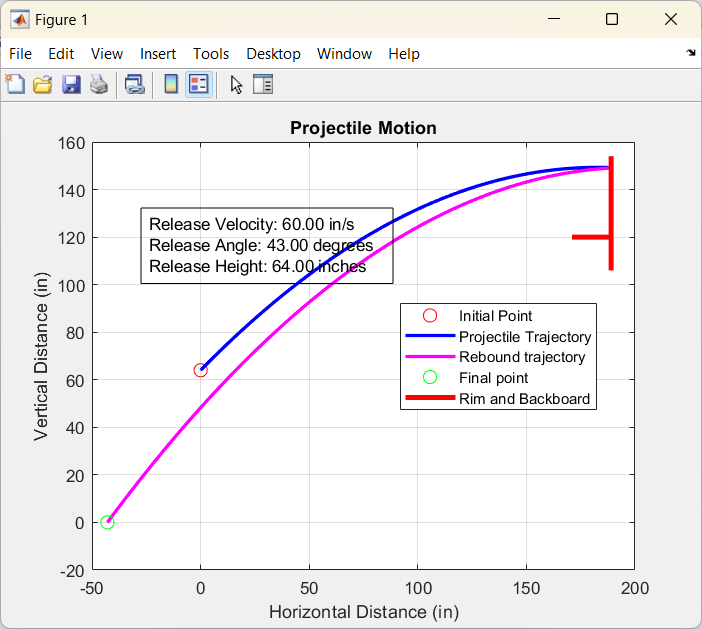
I also built a kinematic trajectory simulator — including backboard-bounce physics — that predicts whether a shot goes in purely from release angle, velocity, and height, so we could sanity-check the tracked data against physical expectation.
Results
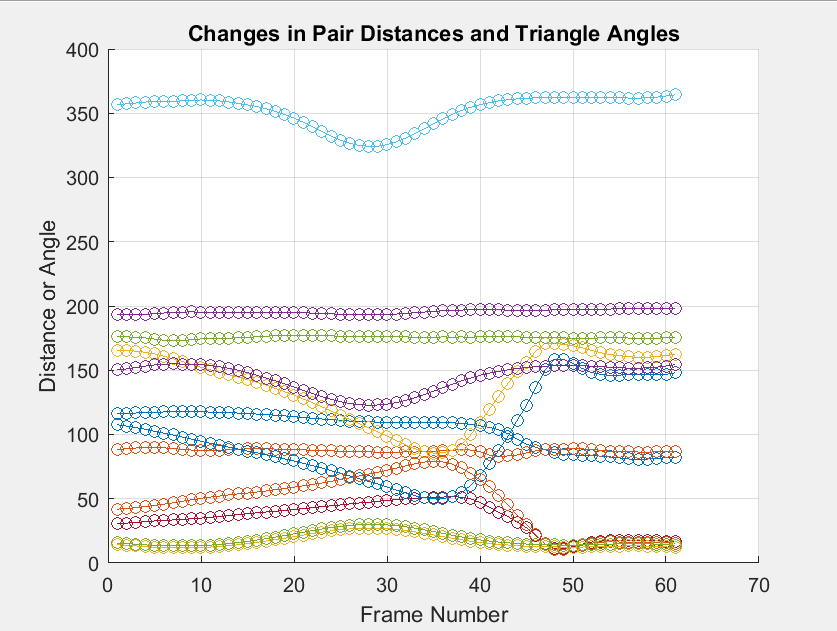
We collected full joint-angle and velocity datasets — elbow angle, knee angle, forearm angle, release angle, ball velocity — across six subjects spanning skill levels, including four Purdue Division-I players (Zach Edey, Lance Jones, Chase Martin, Carson Barrett), for both free throws and three-pointers, splitting makes from misses. 3D scatter plots of the resulting data showed visible separation between makes and misses on a per-player basis, and the project was featured by Purdue Athletics and Mechanical Engineering as a research profile.
Why this matters for sports tech
This project is where the sensor-and-biomechanics instincts behind Shot‑Sync actually came from — same joint-angle variables, same collaborators, and the direct predecessor to a hardware product. It's also a small case study in getting real signal out of a cheap sensor setup: something equipment R&D teams care about constantly, whether the sensor is a $30 IMU or two iPhones on tripods.