The problem
A head-to-head robotics competition: build an autonomous robot that navigates a course, identifies targets, and delivers "packages" faster and more reliably than the other teams' robots — with no partial credit for a robot that works in the lab but chokes on race day.
Approach
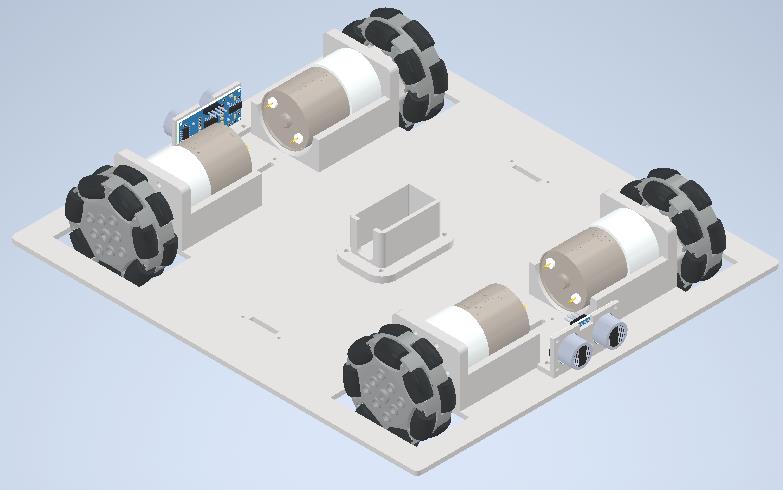
The robot runs on a finite-state-machine architecture governing navigation, target detection, and delivery behavior, with PID control handling line-following and centering against the course. Getting reliable sensor input took as much work as the control logic itself: ultrasonic sensors needed bias correction, IR thresholds needed tuning per lighting condition, and a magnetic-field sensor needed calibration against ambient interference before its readings could be trusted. Two motor-driver boards handle four drive motors plus a flywheel launcher and turntable mechanism, all coordinated through the central Mega 2560.
Why this is on the site
It's the deepest embedded-systems and controls project in my portfolio — real-time state logic, closed-loop PID tuning, and getting several noisy physical sensors to agree with each other, all under the added constraint that it had to work on demand, once, in front of judges.