The problem
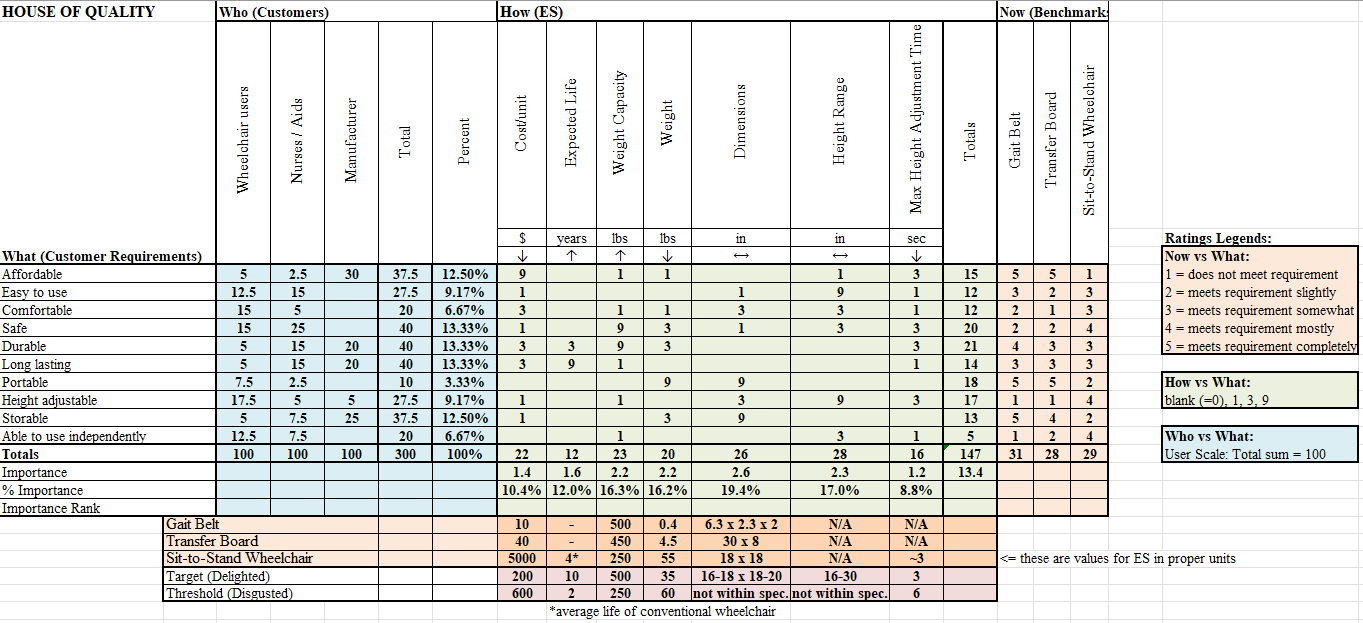
Standard wheelchairs force caregivers into awkward, back-straining transfers, and force users to give up independence in getting into and out of the chair. Our target customer requirement, quantified through a formal House of Quality: an affordable, easy-to-use, adjustable-height wheelchair that reduces physical strain on both the user and anyone assisting them — without pricing itself out of reach.
Approach
We ran the requirements through a full House of Quality to translate qualitative needs ("comfortable," "safe," "storable") into weighted, measurable engineering targets — cost per unit, weight capacity, height-adjustment time, footprint — benchmarked directly against existing alternatives like gait belts and sit-to-stand wheelchairs. That drove the concept toward a scissor-lever lift mechanism, which we developed in SolidWorks across three progress reviews, refining the mechanical-advantage geometry and part selection at each stage.
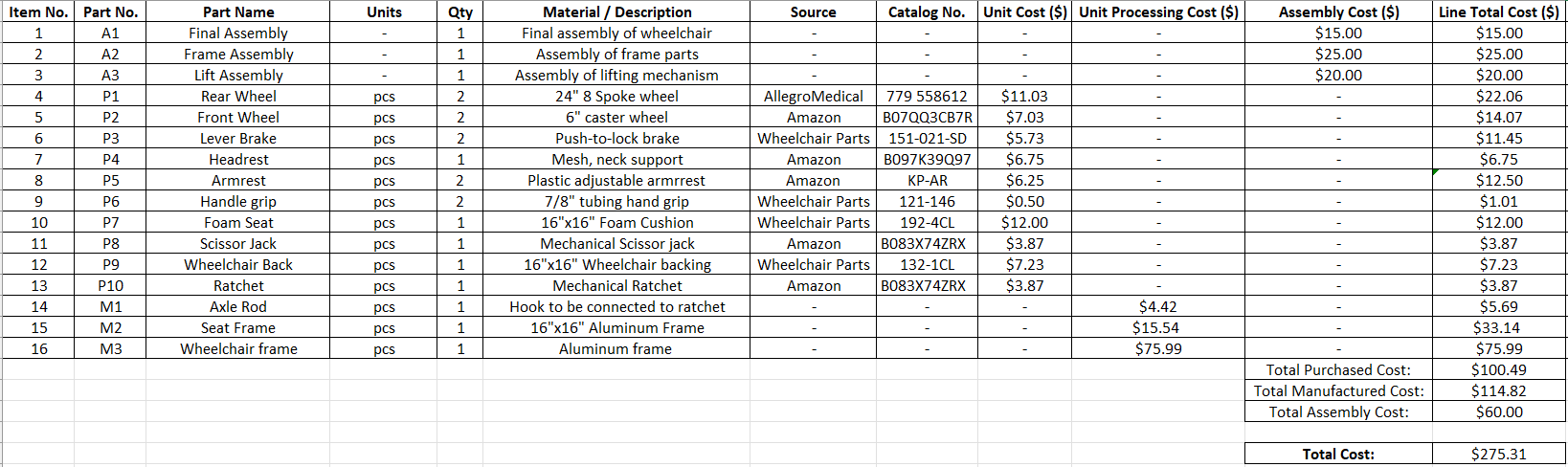
Each phase carried its own costed bill of materials, and the final design was backed by an NPV, ROI, and break-even analysis to make the business case for the concept, not just the engineering case.
Result
A working scissor-lever prototype with a fully costed BOM and a defensible economic case, presented as a final poster after three rounds of design iteration. It's the clearest "concept through prototype" lifecycle project in my portfolio — QFD in, working hardware and a costed BOM out.